Swiss taxes for expats in the first year: what to decide, when to act, and where it goes wrong
Your first year as a Swiss tax resident is shaped by a handful of decisions — each with a specific deadline and real financial consequences if handled incorrectly.
Unlike most countries, where a single national authority governs taxation, Switzerland operates a layered system across federal, cantonal, and municipal levels, with rules that differ depending on your residence permit, your canton, and your personal circumstances. This makes it easy to get things wrong without realising it — often for months.
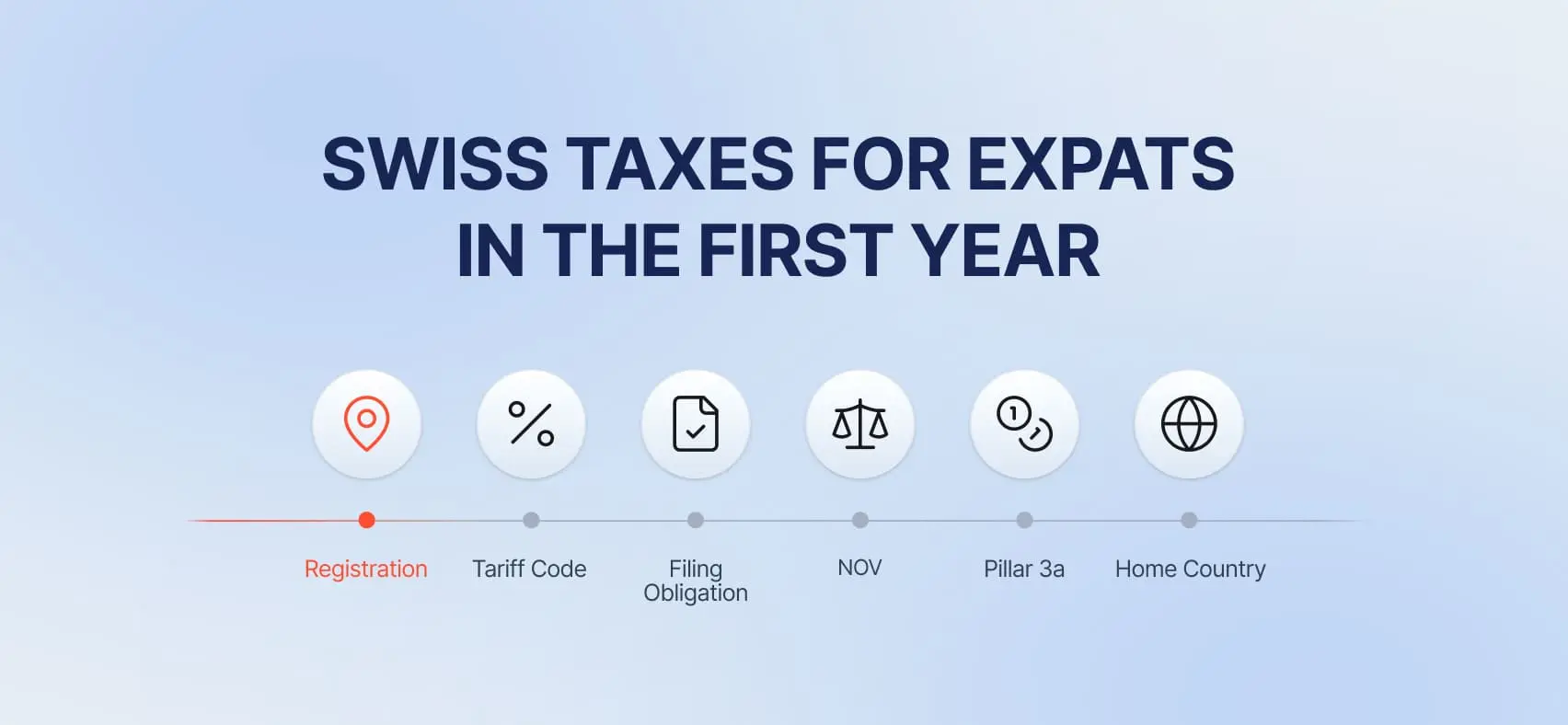
This guide on Swiss taxes for expats is structured around the six key decisions you’ll face between the day you arrive and your first filing deadline. For each one, we cover what to do, when to act, and the most common mistakes at that stage.
Decision 1: Where you register — and why it’s a financial choice, not just an administrative one
When to act: Your first week in Switzerland.
What to do: Register at your local municipality (Einwohnerkontrolle / Contrôle des habitants). Before signing a lease, spend thirty minutes on your canton’s online tax calculator. Enter the same income figure for two or three municipalities you’re considering and compare the results. The gap between them may reshape your housing priorities.
Your Swiss tax residency starts on the exact date of this registration — not January 1, not the date on your employment contract. Everything flows from this moment: when your obligation begins, and which rates are applied to your earnings.
Common mistake at this stage: In countries with a single national tax rate, your address has no bearing on what you owe. Switzerland works differently. Municipalities set their own tax multipliers, and two towns fifteen minutes apart — within the same canton — can produce annual tax bills that differ by thousands of francs. Choosing where to live without checking the tax implications is one of the most expensive first-year oversights, and one of the simplest to prevent.
Decision 2: Checking your tariff code — before it quietly costs you money for twelve months
When to act: The day you receive your first pay statement.
What to do: Locate the short alphanumeric tariff code on your pay statement — something like A0N, B1Y, or C2N. Confirm that each character matches your actual situation:
The opening letter captures your household setup (A = single, B = one-income marriage, C = two-income marriage, H = single parent). The number in the middle reflects how many dependent children you have. The closing letter signals church tax: Y means you belong to a recognized denomination covered under your canton’s withholding tax rules (typically Roman Catholic or Protestant Reformed, though the denominations included vary by canton), N means you do not.
If anything is incorrect, notify your employer and your cantonal tax authority without delay.
Common mistake at this stage: In most other countries, payroll tax codes are managed centrally and errors are caught by automated systems. The Swiss approach relies on the accuracy of information provided during onboarding — and corrections don’t happen unless someone initiates them.
The most frequent error: the church tax indicator set to Y for someone with no recognized denomination. That single wrong character adds a surcharge to every paycheck, and it can persist for a full year or longer without anyone flagging it.
A related error for couples: when a non-working partner begins employment (or vice versa), the tariff code must be updated from single-income to dual-income household or the reverse. The monthly difference between these codes is substantial, and delays of six months or more in making the update are common.
Decision 3: Understanding whether the payroll deduction is your entire tax picture — or just the beginning
When to act: Within your first three months, so you can plan the rest of the year accordingly.
What to do: Determine whether the monthly tax pulled from your salary represents your full and final obligation — or whether additional filing is required. Check with your cantonal tax authority’s website for the specific triggers that apply in your jurisdiction.
In many cases, the payroll deduction settles everything and no further action is needed. But several circumstances independently create a filing obligation: your total gross compensation (including bonuses, relocation packages, and benefits in kind) exceeding CHF 120,000 — a uniform federal threshold that applies across all cantons since 2021; income arriving from outside a Swiss payroll such as foreign rental income, freelance earnings, or investment dividends; accumulated wealth above cantonal reporting limits; or ownership of Swiss real estate.
Common mistake at this stage: The compensation threshold applies to total gross pay — not just base salary. A year-end bonus, a signing payment, or a housing allowance can push an otherwise comfortable margin over the line. Discovering this in January, after the year has closed, makes organizing deductions retroactively far more difficult.
A second frequent error: collecting modest rental income from property abroad without realizing it triggers a Swiss filing obligation. The threshold in some cantons is surprisingly low.
A third, specific to newcomers from countries without annual wealth declarations: Switzerland requires disclosure of worldwide assets on your return. Foreign savings, brokerage accounts, property, and insurance policies with cash value must all appear. These holdings may not generate a large direct Swiss tax bill, but they influence the rate applied to your Swiss income through the progression method — pushing your effective percentage upward even when the foreign assets themselves are exempt from direct Swiss taxation.
Decision 4: Requesting a voluntary ordinary assessment — the one-way door
When to act: Before the cantonal cutoff date in the year following the tax year in question — so if you arrived in 2025, the deadline for that first partial year is March 31, 2026. In most cantons, this falls on March 31, but your cantonal authority can confirm whether a different date applies.
What to do: If no mandatory filing trigger applies to you, consider whether requesting a Nachträgliche Ordentliche Veranlagung (NOV) would be beneficial. This is a decision that should be based on precise calculations, not estimates. We recommend exploring our withholding tax services for expats or booking a consultation with our tax expert, who will run the numbers for your specific situation — comparing what you’ve paid through the payroll system against what an ordinary assessment would produce — so you can make this commitment with full clarity on the outcome.
Common mistake at this stage: Two opposite errors, both equally frequent.
The first: submitting the request without doing the math. What many expats don’t realize is that a voluntary NOV isn’t a one-time experiment — it’s a binding, lifelong switch within the Swiss withholding framework. The reform that took effect at the start of 2021 made this explicit: once you file the request, you will receive ordinary assessment forms every year until your Quellensteuer obligation ends, whether through obtaining a C permit, marrying a Swiss citizen, or leaving the country. There is no cooling-off period, no way to withdraw the request after submission, and no mechanism to return to the simpler payroll-only arrangement. If your municipality’s actual tax multiplier turns out to be higher than the blended cantonal average that the payroll system was using, your annual bill goes up — and stays up for as long as you remain in that municipality under the same permit.
The second: missing the submission window entirely. The cutoff is a Verwirkungsfrist — after it passes, that year’s recalculation option is permanently closed.
Decision 5: Funding a Pillar 3a account — and understanding why the tax benefit isn’t automatic
When to act: Before December 31 of your arrival year.
What to do: Open a Pillar 3a (Säule 3a) retirement account at a Swiss bank or online platform — the process takes under an hour — and transfer money into it before the calendar year ends. What you deposit lowers your taxable income for that year, up to the government-set annual ceiling.
Common mistake at this stage: The most frequent error is simply running out of time.
The second involves a gap between the deposit and the paperwork. Your employer’s monthly tax calculation runs independently of your Pillar 3a activity. The only way to convert the deposit into a tax reduction is by submitting a declaration that includes it — and for someone who has no mandatory reason to file, that means going through the NOV process described above, with its permanent consequences.
Decision 6: Settling your tax obligations in the country you left
When to act: Within your first six months — ideally before your home country’s next applicable filing deadline.
What to do: Identify what your previous country of residence requires from you in the year of departure. Most countries expect a departure-year declaration covering the months you remained tax-resident there. Bilateral treaties between Switzerland and your home country determine which government taxes which income during the crossover period — review the applicable treaty or seek professional guidance on how it applies to your situation.
If your home country continues to impose filing obligations on citizens living abroad (as the United States does), establish an ongoing compliance routine from year one. If you have unfiled returns, the taxes for expats streamlined procedure (applicable to US citizens through the IRS Streamlined Foreign Offshore program) or equivalent programs in other jurisdictions may offer a path to compliance without penalties — but only with proactive action.
Common mistake at this stage: Treating the home-country filing as an afterthought.
How do taxes work for expats who leave this coordination to the last minute? The result is typically penalty assessments, retroactive interest, and unnecessary complications — all avoidable with early attention.
When are taxes due for expats?
If you file a declaration, the standard submission date falls on March 31 of the following year in most cantons, though some set different dates. Extensions are commonly available.
The deadline that carries the highest stakes is the NOV submission cutoff — March 31 in most jurisdictions, though you should confirm the applicable date with your cantonal authority. It is the final moment to request a voluntary recalculation and the last chance to claim deductions such as Pillar 3a. Once it passes, whatever the rate tables produced becomes your final tax picture for that year.
After any declaration is processed, the cantonal office sends a formal assessment notice (Veranlagungsverfügung). You’ll have roughly 30 days to lodge an objection (Einsprache) if something looks incorrect. Errors in these notices do occur — a wrong tariff applied, deductions miscalculated, income items counted twice. This document deserves careful review, not a glance and a drawer.
Your Swiss tax situation, handled by LedgerPeek
From the moment you start thinking about relocating to Switzerland, through your first filing and beyond — LedgerPeek is the partner expats turn to.
Whether you need clarity on your withholding tariff, a second opinion on whether to request an NOV, help with Pillar 3a timing, or full coordination with your home country’s tax authority, we cover it all.
Book a consultation with our expert – and have a stress-free experience with Swiss taxes.